
THIS STORY IS AVAILABLE IN THE ANGELS STROKE HEROES PODCAST

History was made at the 1980 Winter Olympics in Lake Placid, New York, when a US ice hockey team composed of college-age amateurs defeated a Soviet team of seasoned professionals. Through sheer teamwork and belief, a group of second-tier talents had defied 1,000-to-1 odds to defeat the heavily favoured, four-time defending gold medalists in a contest that would become known as the Miracle on Ice.
This iconic moment delivered sport’s quintessential example of the whole being greater than the sum of its parts – a philosophical concept (often attributed to Aristotle) which highlights synergy and the idea that organized systems possess value beyond their separate elements.
This kind of synergy, namely the superior power of a group of things working together in a single, coordinated system, is at the core of a set of evidence-based, structured interventions associated with improved outcomes for patients with intracerebral hemorrhage (ICH).
The ICH care bundle
Intracerebral haemorrhage is the most serious and least treatable form of stroke. Although it accounts for only 28.8 percent of all strokes, ICH is responsible for 45.6 percent of deaths and nearly half of all lost disability-adjusted life years (DALYs). But while the past three to four decades saw great strides in the treatment of acute ischemic stroke (AIS), the fate of ICH patients remained largely unchanged, until the conclusion of studies such as the INTERACT3 clinical research project in 2023.
INTERACT3 showed that timely administration of a care bundle that included lowering of systolic blood pressure, strict glucose control, treatment of fever, and rapid reversal of anticoagulation led to less disability, lower rates of death, and better overall quality of life.
These results were incorporated in the 2025 update of ESO and EANS guidelines for managing intracerebral haemorrhage released at ESOC in Helsinki. During the same conference, INTERACT3 lead investigator and WSO president-elect Prof Craig Anderson made the case for the care bundle in a panel discussion with Professors Pachi Moniche and Robert Mikulik that was initiated and recorded by Angels.
This discussion was the starting point for Madeline Bucher and Inês Carvalho after they accepted a brief to create standardized tools to support the implementation of the ICH care bundle in hospitals.
A multi-platform strategy
Synergy is at the heart of a strategy that has helped create a global community of more and improved stroke centres and stroke-ready hospitals that should see more than 50 million stroke patients receive evidence-based care in Angels hospitals by 2030.
The Angels Initiative employs a multi-platform behaviour change strategy consisting of five principles, namely consultancy, standardisation, education, quality monitoring and community.
Like the ICH care bundle, this is an example of an organized system having impact beyond its separate elements. For the Angels strategy to succeed, none of the five principles can be excluded. All five platforms must be activated for behaviour change to take place.
This includes scripting the critical moves in a process of standardisation, equipping healthcare workers with skills and knowledge to provide the highest standard of care, instilling a culture of quality monitoring to track performance, and building a stroke community committed to excellence. Central to it all is the deployment of a field force of consultants to support every lever of implementation – all at the same time.
The five platforms amount to a structured, holistic approach to implementation that ensures every project is given the best chance of success.
Scripting the critical moves
As Madeline and Inês set out to script the critical moves for implementing the ICH care bundle, they found themselves in a familiar gap between evidence and practice, where complexity is the enemy of change.
New clinical discoveries are constantly adding to the complexity of diagnostic and therapeutic decision-making to the point where it exceeds the available time and cognitive resources. For this reason, convincing more hospitals to start treating stroke patients according to evidence-based guidelines means stripping away all but the most relevant information to provide clear, user-friendly recommendations that make the minimum necessary steps explicit, thereby removing the barriers to implementation. In other words, you need a checklist.
Breaking down complex, high-pressure tasks into manageable steps can improve anything from airline safety to surgery survival rates. But getting from complex to simple is more easily said than done. In the words of entrepreneur Richard Branson, “Any fool can make something complicated. It is hard to make something simple.”
Ask the experts
Tasked with creating tools to standardize and support ICH care pathway implementation, and with “as soon as possible” as their deadline, Madeline and Inês went to work shortly after ESOC 2025. They were reading, asking questions, and articulating new concepts.
Based in Germany and Portugal respectively, they checked in with each other regularly to compare notes and exchange ideas. And if they weren’t sure they’d understood the material correctly, they appealed to experts including Prof Thorsten Steiner, chair of the European Stroke ESO ICH committee and of the guideline update, and ESO guidelines board co-chair Prof Diana Aguiar de Sousa, along with neuroradiologist Dr Jaime Pamplona and Dr Ana Nunes, both at the University of Lisbon.
The ICH pathway resembles the AIS pathway up to the CT room, where imaging will confirm (or rule out) the presence and location of hemorrhage. A confirmed diagnosis triggers the four steps of the ICH care bundle – early intensive blood pressure treatment, glucose and temperature management, early reversal of abnormal anticoagulation, and early consulting of neurosurgery.
None of the key actions that make up the ICH care bundle are new, nor do they individually require specialist training or equipment, Madeline and Inês say. This means it can be implemented even in low-resource settings, which tend to be associated with a higher and often younger incidence of ICH.
What is however new is the introduction of timing and targets (for example, systolic blood pressure should reach the target of less than 140 mmHg in under one hour), and the high levels of coordination required to activate the synergic effect. This is where a well-designed checklist is indispensable, one that is rooted in a deep understanding of the science, but is itself concise, clear and unambiguous, and allows professionals to carry out complex tasks with high efficiency and minimal error.
Back to school
Mining the literature, engaging with the complexity, articulating the core meanings – Madeline and Inês had done all this before. Madeline studied molecular biology and holds a PhD from the University of Heidelberg, Germany. Inês studied pharmaceutical sciences and received her PhD in pharmaceutical chemistry and therapeutics from the University of Lisbon.
But it had been a while since they hit the books. As Angels consultant in Portugal since 2022, Inês is mainly concerned with implementation, while Madeline’s role as project manager in the Angels core team draws more on her organizational than scientific gifts.
“I really enjoyed it,” Madeline says of reimmersing herself in the field of science. It’s something she wants more of. Both she and Inês found it intensely meaningful to have a chance to change people’s lives not only as implementers but as creators of life-saving tools.
Constantly thinking about how to organize the information and how to express new concepts fluently and coherently did mean her work became fused with her personal life, Inês says. But it didn’t feel like work. “I loved it.”
The five platforms in action
The ICH project has now entered its pilot phase. It has already been activated in some hospitals in Portugal that will monitor door-to-treatment times before and after implementation of the checklist. An elearning designed by Madeline and Inês will shortly be available in the Angels Academy, and the process of translating the materials into all 20 languages available on the Angels website is almost complete.
Their work has earned praise from Prof Steiner himself. But as Spanish author Miguel de Cervantes wrote 500 years ago, the proof of the pudding is in the eating. It is results that determine value – and success.
With the standardization and education platforms solidly established, attention turns to measuring success and supporting continuous improvement via quality motoring. This means ICH quality indicators being incorporated into RES-Q and as criteria for the WSO and ESO Angels Awards.
Madeline and Inês are optimistic that the ICH care bundle will encounter less hesitation than acute treatments for ischemic stroke in some settings. “The research is new but the actions are not new,” they say, although they acknowledge that all change is hard and hospitals need to become convinced by the care bundle concept.
Inês says: “Things only move forward when you push.”
Moving things forward will be the work of the Angels field force of compassionate, courageous and committed consultants, who day after day, help hospitals overcome complexity in order to change outcomes for stroke patients around the world.
Finally, change will be sustained by continuing to welcome doctors and nurses to the Angels community, among other things by telling stories such as this one.

What’s in the script
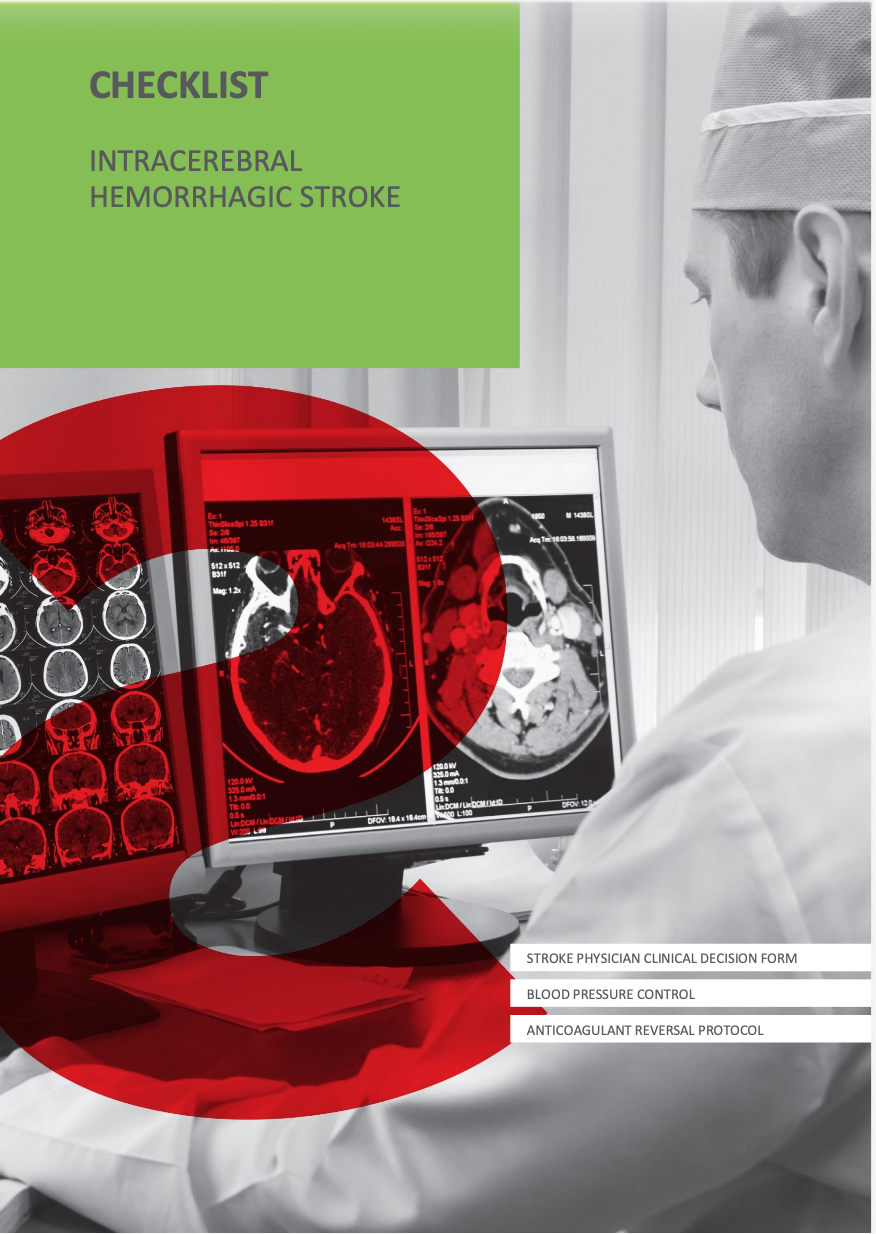
The five-page checklist for intracerebral haemorrhagic stroke is composed of three parts – Clinical Assessment and Imaging, ICH Management (using the care bundle), and Dosing Tables for blood pressure control and anticoagulant reversal. It consists of closed fields and multiple‑choice options and is practical and easy to use even if stroke teams don’t have detailed knowledge of the underlying guidelines, Madeline and Inês say.
The Clinical Assessment and Imaging section has fields for Patient Assessment (symptoms, symptom onset, medications, medical conditions, and blood pressure, INR and blood glucose on admission), Severity (NIHSS score, Glasgow Coma Scale and ICH score), and Diagnosis (imaging observations including location of hemorrhage).
The ICH Management section provides step-by-step coverage of the actions that make up the care bundle. These are: blood pressure treatment (with a door-to-target time under 60 minutes), anticoagulant therapy reversal (door-to-treatment time under 60 minutes), and blood glucose and temperature management, the latter with a door-to-target time under 60 minutes. It also offers guidance for early consulting of neurosurgery, with tick boxes for types of intracranial bleeding, and a dedicated field for recording the surgical decision.
More science, please
For Madeline and Inês, working on the ICH project has reawakened their love of science, and they’re not hanging up their lab coats just yet. Madeline is looking for gaps among the courses in the Angels Academy and believes there are opportunities for expanding the elearning materials for post-acute care, also taking into account allied health specialists such as physiotherapists and speech therapists.
Inês is contemplating the complexity of merging the ICH and AIS pathways into a single document, or tackling door-to-groin times by developing key priority actions that streamline the thrombectomy pathway.
It is generally held to be inevitable that the process of initiating transformation also reshapes the individuals driving it. So it is not too far-fetched to think that in the process of creating tools that save lives, you may just catch yourself changing your own.


